Industrial Accessories
Your Professional Industrial Accessories Supplier!
Since its establishment in 2000, Shandong Hualv Shares Co., Ltd., affiliated to Shandong Huajian Aluminium Group, has become one of the earliest large-scale enterprises in China engaged in the lightweight deep processing industry. Our product range includes a variety of products, such as cargo compartments, automobile series, new energy series, wind energy series, photovoltaic series, and industrial system components.


why choose us
Product Application
Our products are widely used in various industries, including automotive, new energy, aerospace, shipbuilding, and high-speed rail. Our lightweight solutions are ideal for reducing vehicle weight and improving fuel efficiency.
Our Certificate
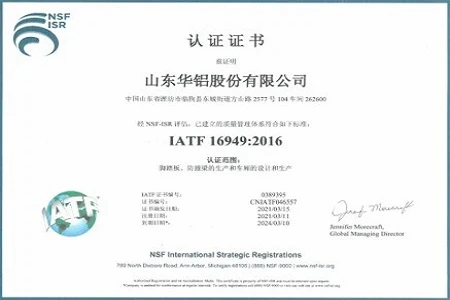
We have obtained numerous certifications and patents, including Qualicoat, CE, Intertek, and NFRC certificates. Our company has also been awarded the IATF16949:2016 quality management system certification, as well as other related certifications.
Production Equipment
Our factory is equipped with advanced production equipment, including extrusion machines, casting machines, CNC processing centers, automatic welding workstations, five-axis machining centers, laser cutters, and more.
Production Market
Our products are exported to more than 40 countries worldwide, and we have established strategic cooperations with globally renowned aluminum products manufacturers and lightweight accessory research and development enterprises.
Our best-selling product types
Aluminum Helicopter Platform
The helicopter platform, commonly known as the helicopter deck, refers to the site on land high-rise buildings, offshore structures (such as fixed platforms, mobile platforms and ships, etc.) where helicopters land and take off.
Al Heat Sink
Aluminum profile is a common and widely used radiator material. It is made of high-purity aluminum alloy and has the characteristics of light weight, good thermal conductivity, and strong plasticity.
Aluminum Flight Box
The aviation case is a box specially designed for air transportation. The main purpose of its design is to ensure that the goods are protected to the greatest extent during transportation. This kind of box usually has characteristics such as high strength, light weight, durability, and shock resistance to meet the special requirements of air transportation.
Aluminum Helicopter Platform Specification
|
Item |
Specification / Description |
|
Product Name |
Aluminum Helicopter Platform |
|
Material |
High-strength aluminum alloy |
|
Deck Structure |
Aluminum deck plates on horizontal frame |
|
Frame & Connections |
Bolted aluminum beams; optional riveting or welding |
|
Weight Advantage |
35%–50% of comparable steel platform |
|
Corrosion Resistance |
Natural oxide layer provides high corrosion resistance |
|
Typical Applications |
Offshore platforms, ships, engineering sites requiring helicopter landing |
|
Key Benefits |
Lightweight, corrosion-resistant, long service life, easy installation |
Aluminum Helicopter Platform Key Features

Solid Foundation:
Made from premium-grade aluminum, our platforms offer robustness while being inherently resistant to corrosion, ensuring a lasting structure.

Light Yet Sturdy:
The innate lightness of aluminum translates to platforms that are easy to assemble and relocate, without ever compromising on their load-bearing capacity.

Enhanced Safety:
Each platform is meticulously designed with anti-skid surfaces, ensuring every step taken is secure and confident.

Eco-Conscious Choice:
Favoring aluminum not only guarantees durability but also supports sustainability, given its recyclability.
Emergency Medical Services (EMS): In medical emergencies, rapid response times are crucial. Aluminum helicopter platforms enable helicopters to land closer to accident sites, hospitals, and other critical locations, facilitating quicker patient transport and improving survival rates.
Military Operations: Aluminum helicopter platforms are vital for military logistics and combat operations. They allow for the establishment of temporary bases, forward operating positions, and medical evacuation points, enhancing operational efficiency and flexibility.
Disaster Response and Humanitarian Aid:
Natural disasters and humanitarian crises often require swift and flexible responses. Aluminum helicopter platforms support relief efforts by providing landing sites for helicopters delivering aid, conducting evacuations, and transporting personnel in affected areas.
Remote and Offshore Locations:
Industries such as oil and gas, mining, and scientific research frequently operate in remote or offshore locations where permanent helipads are impractical. Aluminum helicopter platforms offer a viable solution for these operations, ensuring safe and efficient helicopter access.
Events and Filming:
Major events, film productions, and VIP transportation often require temporary helipads. Aluminum helicopter platforms provide a convenient and adaptable solution for these short-term needs, ensuring safe and efficient helicopter operations.
Al Heat Sink Specification
|
Item |
Specification |
|
Material |
Aluminum alloy |
|
Features |
Lightweight, high thermal conductivity, easy to shape |
|
Form |
Extruded profiles, customizable sizes |
|
Surface Finish |
Anodized, painted, or plain |
|
Customization |
Size and shape can be tailored |
|
Applications |
Electronics cooling, industrial equipment, LED lighting |
|
Weight |
Depends on design |
Key Features and Advantages of Al Heat Sink
Thermal Conductivity:
Aluminum boasts good thermal conductivity, meaning it can efficiently transfer heat away from the heat source (e.g., a CPU or GPU) and into the surrounding air.
Lightweight:
Aluminum is a lightweight material, making it suitable for a wide range of applications without adding excessive weight to the device.
Cost-Effective:
Aluminum is an affordable material, making aluminum heatsinks a cost-effective choice for manufacturers.
Corrosion Resistance:
Aluminum naturally forms a thin layer of oxide that provides corrosion resistance, ensuring the heatsink's durability.
Al heat sinks generally consist of a solid base with protrusions sticking out of it. But the form and size of these protrusions affects how the heat sink performs. The most common heat sink varieties include:
Pin-fin heat sink: Pin-fin heat sinks have pins that extend from the base. They offer the largest surface area of all heat sink types and are best in low airflow (or random/multidirectional airflow) situations. The pins can have different shapes: Cylindrical, Elliptical, Square.
Plate fin heat sink: More common than pin-fin heat sinks, plate fin heat sinks have rectangular fins that extend from the base. They are the best type of heat sink when airflow is unidirectional.
Flared fin heat sink: A variation of the plate fin heat sink, flared fin heat sinks have a flared fin arrangement and decrease flow resistance.

Al Heat Sink Material
|
Alloy |
Thermal Conductivity (W/mK) |
Relative Cost |
Strengths |
|
1050A |
229-235 |
Moderate |
Excellent thermal conductivity, Good corrosion resistance |
|
1070 |
225-229 |
Moderate-High |
Very high thermal conductivity |
|
6061-T6 |
167-173 |
Low-Moderate |
Excellent machinability, Good strength |
|
6063-T5 |
209-218 |
Low |
Superior extrudability, Good thermal performance |
Al Heat Sink Density
|
Property |
Aluminum |
|
Thermal Conductivity (W/mK) |
237 |
|
Density (g/cm³) |
2.7 |
|
Specific Heat (J/g·K) |
0.91 |
|
Relative Cost |
Lower |
|
Machinability |
Excellent |
Basic Principles of Al Heat Sink
Heat Absorption:
The aluminum heatsink is in direct contact with the heat source, such as a CPU or GPU. As these components generate heat, the heatsink absorbs it.
Heat Dissipation:
The absorbed heat is then transferred through the aluminum material to the heatsink's fins. The increased surface area of the fins allows for efficient heat dissipation.
Airflow:
To enhance cooling, a fan or natural airflow across the heatsink's fins is used to carry the heat away into the surrounding environment.
Repeat Process:
This process continues as long as the electronic component is in operation, preventing overheating and potential damage.
Al Heat Sink Surface Treatments
Anodizing:
While primarily used for corrosion protection and aesthetics, anodizing slightly reduces thermal conductivity (typically 1-3%) but can increase emissivity by up to 80%, improving radiative heat transfer.
Black Anodizing:
Particularly beneficial for radiation-dominant cooling scenarios, increasing emissivity to 0.8-0.9 compared to 0.03-0.05 for bare aluminum.
Chromate Conversion Coatings:
Minimal impact on thermal performance while providing good corrosion protection.
Al Heat Sink Manufacturing Process
Extrusion
Extrusion, the process of forcing hot metal billets through a steel die, is the most common way of making aluminum heat sinks. It is a fast, effective, and economic method for making heat sinks out of ductile materials like aluminum 1050. Extruded aluminum heat sinks are typically anodized before use.
Skiving
Skiving or scarfing, the process of cutting material into slices, is a common manufacturing process for the production of plate fin and flared fin heat sinks. The process allows for thinner and more closely packed fins than extrusion, and also provides a level or surface roughness, which slightly increases the total surface area.

Casting
Casting, the process of pouring molten metal into a mold, is another way to make heat sinks — aluminum or copper. Pressure die cast heat sinks can have a high level of complexity and offer excellent mechanical properties. Die casting is also sometimes used to make zinc heat sinks.
Milling
Milling, the subtractive process of cutting material from a blank workpiece, is an affordable way to make heat sinks with virtually any geometrical shape, from materials like aluminum alloys. Milled heat sinks (or machined heat sinks) may be more expensive than alternatives, especially in large quantities, but they can also be made very quickly.
Consumer Electronics
Aluminum heat sinks are widely used in consumer electronics, such as laptops, smartphones, and gaming consoles. They help manage the heat generated by CPUs, GPUs, and power supplies, ensuring stable performance and preventing overheating.
Automotive Industry
In automotive applications, aluminum heat sinks play a role in electric vehicle battery management, engine cooling, and even in LED headlights.
Industrial Machinery
Industrial applications, such as power converters, telecommunications, and HVAC systems, benefit from aluminum heat sinks to manage heat in high-power environments.
Packaging and Shipping
|
Packaging |
Wooden box |
|
Transportation methods |
Road transport, rail transport, sea transport, air transport |
Our Certificate